

How it started
In Colombia, despite high electrification rates, approximately 495,000 households lack access to reliable energy, with another 500,000 relying on expensive diesel generators that rarely provide 24-hour service.
Lack of energy access worsens poverty and social inequality. It limits internet use, gives children less time to study, and forces women to complete household chores during the day, making gender gaps even wider. It also impacts food security—without proper refrigeration and storage, food spoils quickly, leading to waste and malnutrition.
These households are located in dispersed and rural communities where providing access to an electrical network is expensive and logistically complicated. The lack of reliable energy makes it costly for companies or government entities to offer the services needed to deliver energy access to remote communities, making it unattainable for low-income rural households.
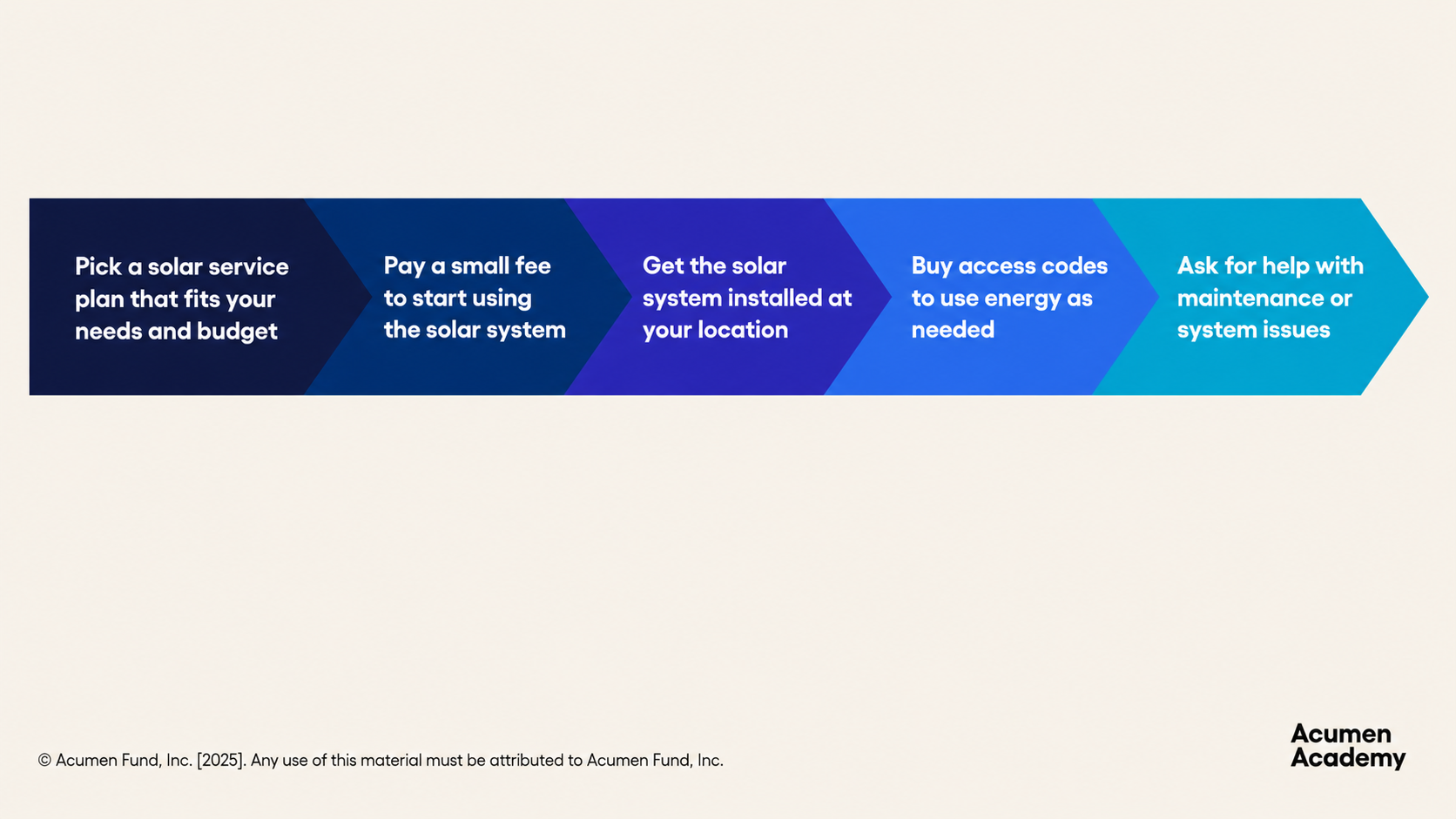
Soluna Energia has stepped in with a solution. The social enterprise provides 24/7 solar energy supply to Colombia’s off-grid and poor-grid regions through a flexible pricing model tailored to customers' needs and financial capabilities. Households can choose between four different levels of solar services based on their energy requirements and ability to pay. Users pay a small upfront fee to install a solar system, which includes a solar panel, battery bank, and all necessary components.
Soluna’s service is a seamless user experience, and the company’s pricing model makes it possible for customers to afford services while keeping the company sustainably profitable. Customers simply purchase access codes to use the system for a day, week, or month, depending on their needs.
Soluna's customer journey

The problem
Households across rural Colombia lack access to electricity, but bringing solar energy systems to market and transporting and installing them for low-income customers in rural areas is costly for both businesses and consumers.
The solution
Social enterprise Soluna Energia provides 24/7 affordable and accessible energy access to Colombia’s rural communities.
The company has built a pricing model that allows them to maintain a profitable, sustainable business while keeping their solar services affordable for low-income households.
Why it matters
By making their product appealing and affordable, and their business financially sustainable, Soluna is closing the electrification gap for rural populations, proving that creative business models can offer impactful solutions that help drive people out of poverty.
The foundations of Soluna’s pricing approach
Social enterprises that are trying to operate in areas of market failure, like those trying to bring clean energy to communities not served by the grid, typically have high entry and operational costs due to multiple factors including:
Working in harder to access areas with limited infrastructure.
High upfront capital costs for production and installation of clean energy technology.
Low customer understanding results in low motivation to adopt new technologies and causes low to willingness to pay.
A deeply relational approach is essential for success—social enterprises must navigate a challenge that has eluded both government and private sectors. To advance their missions, they must strategically leverage resources from these sectors while also building strong visibility and lasting trust within the communities they serve1.
Despite these obstacles a social enterprise seeks to achieve financial sustainability, ideally via a profitable revenue model.
How have Soluna navigated these delicate challenges?
This case study will examine their approach and strategies for developing a pricing and financial model that ensures profitability while balancing customer affordability, rapid capital recovery, and sustained customer satisfaction—ultimately delivering reliable solar energy to enhance the livelihoods of families in rural Colombia.
This case study is broken into two sections:
How Soluna finances bringing the products to market.
How they found price points that work for their customers.
To bring their product to market, Soluna relies on direct and third-party investments. They focus on recovering these investments by charging customers installation fees and setting tariffs at an affordable price.
Then, to identify a price point that worked for their rural customers, Soluna refined its approach by employing strategies such as price testing, understanding customers’ needs and realities, and benchmarking to identify value in the marketplace.
1 MDPI. Sustainability: Integrated Approaches to Urban and Regional Development. Article 8533. MDPI. October 2020. https://www.mdpi.com/2071-1050/12/20/8533.
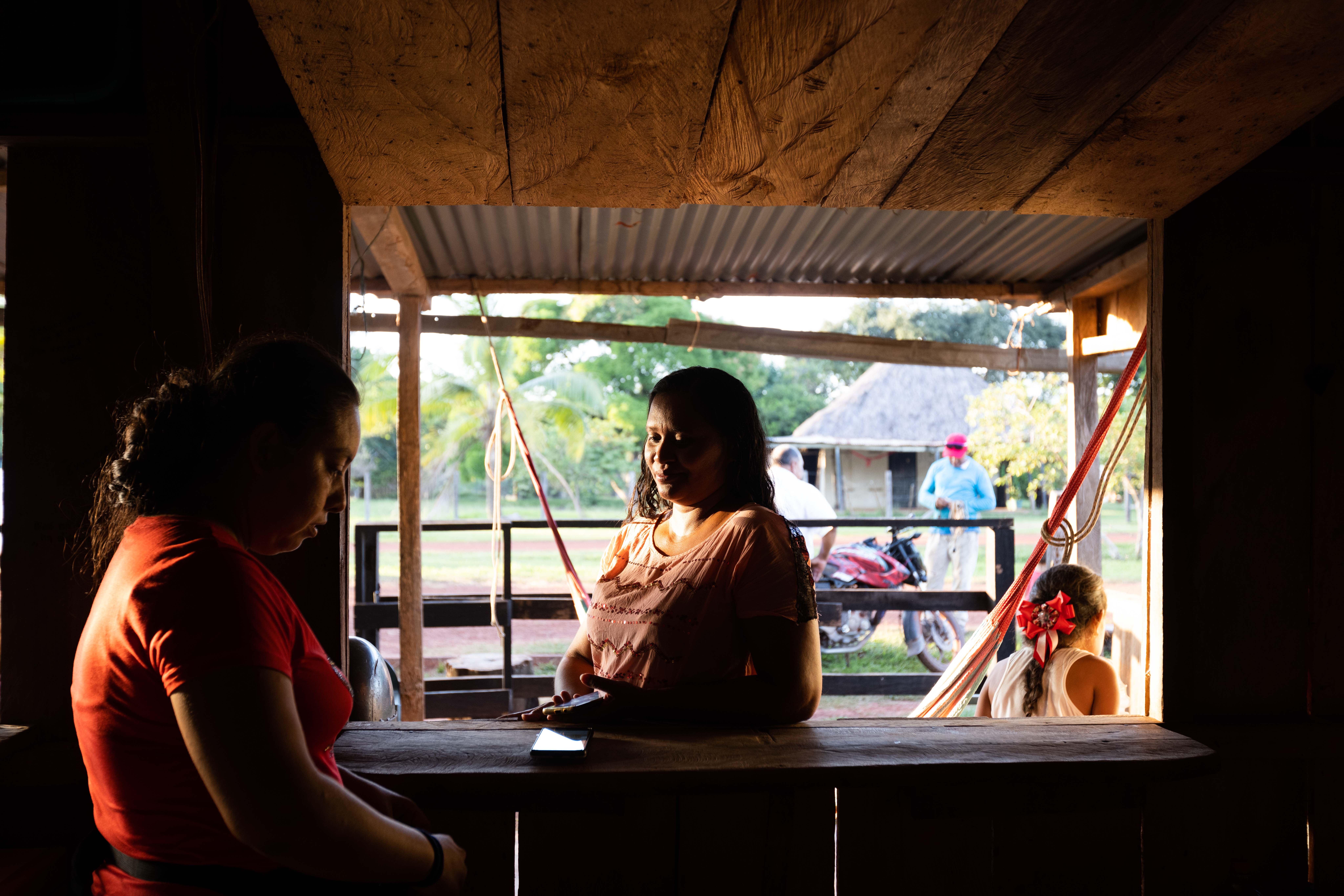
The Business Case: Covering the costs of delivering reliable and affordable energy in rural areas
To bring energy to rural households, Soluna first needed to get its energy systems into the market—a process requiring substantial upfront capital investment. However, passing these costs directly to customers was not an option, as it would exceed their ability to pay.
Soluna uses three approaches to ensure they cover the high capital costs of purchasing and maintaining solar energy equipment while spreading financial burdens over time to minimize the impact on low-income customers.
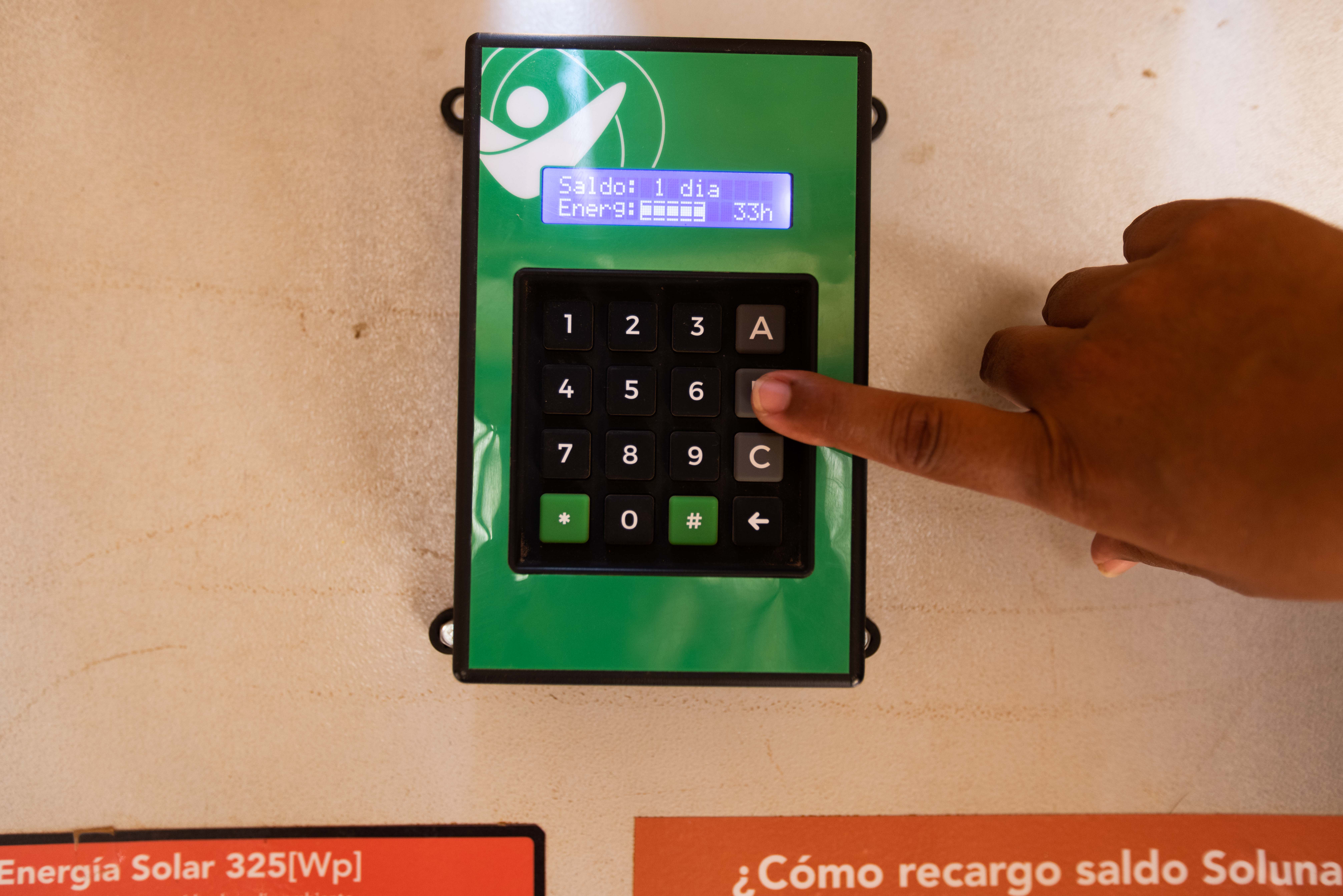
Charge installment fees to ensure customer commitment and recoup some costs upfront
While Soluna finances and pays for the solar systems and installs them in rural homes, through direct investment or their B2B model, customers are charged both an installation fee and monthly charges.
The installation fee goes directly towards covering the cost of transporting and installing the solar system for each household. Customers pay an upfront fee of $300, for example, which directly contributes to paying off the total cost of a $3,000 solar unit over time.
This installation fee also ensures customer loyalty, as it gives customers some "skin in the game," increasing their commitment to Soluna and their solar energy investment.
Recuperate the unit cost within three years via energy access fees
Soluna has a clear goal: recover the cost of each solar system within three years. This target helps Soluna determine how much to charge customers, ensuring they can stay financially sustainable. In order to achieve this, it’s critical that the company maintains complete awareness of its unit economics so the rate they charge customers allows Soluna to fully recuperate these expenses.
How it works
Paying for energy access, not consumption: Instead of charging for the exact amount of energy customers use, Soluna charges for access to a fixed amount of energy each day (e.g., 10 kWh/day).
Predictable payments help Soluna recover costs:
Customers pay a steady, fixed fee each month, making their payments predictable and easy to budget for. The monthly rate varies, but averages $25/month.
For Soluna, these regular payments slowly add up to cover the cost of the system over time and because the payments are consistent, Soluna knows how long it will take to recover their investment.
Soluna recalculates rates, and currently adjusts them in line with inflation, roughly every six months in order to maintain its profitability.
Other things they do to keep costs down
Smart design: The solar systems are meter-operated, so Soluna doesn’t need to make frequent visits to remote areas, which keeps maintenance costs low.
Flexible systems: Soluna’s solar systems are modular, meaning they can grow as families need more energy. If a household wants more power, Soluna can add panels or batteries for a small extra cost. This makes the system more affordable and easy to upgrade.
Through pricing and payment strategies, Soluna has worked to overcome market failures and strike a balance between profitability and affordability.
What strategies can you adopt to help make your business profitable and your product/service affordable to low-paying customers?
Making pricing work for customers: Building a pricing model for customers
The combination of financing the upfront cost of systems, monthly fees, and installment fees help make Soluna sustainable and profitable; however, in order to acquire and retain customers, the company had to find a price point customers were willing to pay.
Slaski and Thurber* identify three challenges for persistent energy poverty: (1) low motivation, (2) low affordability, and (3) low level of user engagement. In order to find a price point that works, Soluna needed to address all three challenges: motivation, actual and perceived affordability, and low engagement.
Soluna used three tactics to tackle these challenges and find a price point that customers were willing to pay.
Testing pricing to determine affordability and willingness to pay
Understanding customers needs and motivations to increase adoption and willingness to pay
Benchmarking against other options, including no energy
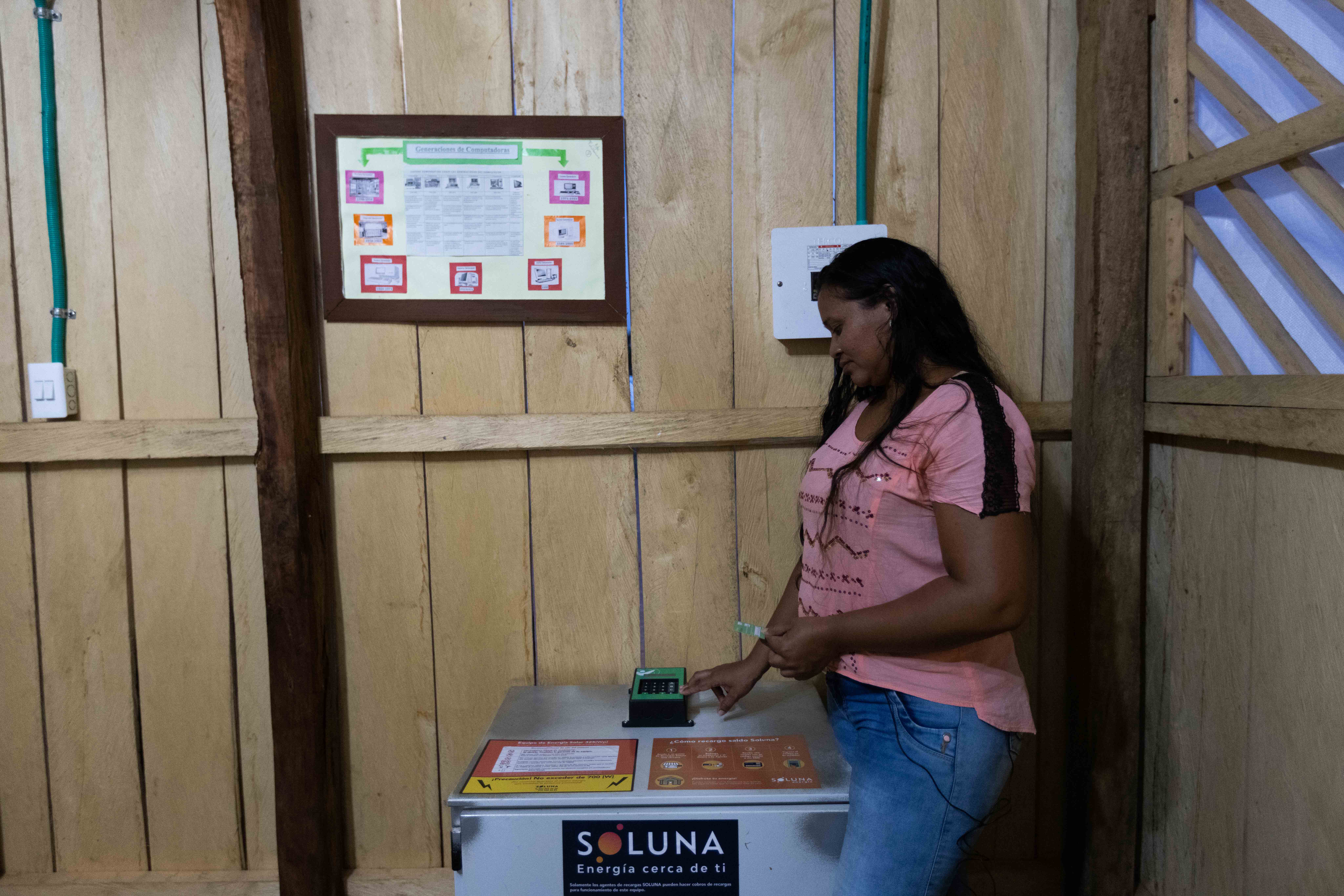
Testing pricing
When initially testing prices, Soluna underestimated customer affordability and the perceived value of energy access.
For example, rates were initially set very low to test affordability in rural areas, but the company has gradually increased their fees (averaging $25/month) as they’ve found some customers can pay more, and are willing to do so as their knowledge and interest in reliable energy access grows over time.
“We define a charge, and we go out into the market, and say ‘let's see who can pay this.’ The best way to know that information is talking to customers. We visit our customers a lot and ask them, what do you think? Is Soluna expensive? Would you be willing to pay a little bit more for a bigger system? That's a great way to see if you’re charging too low. If everyone wants to increase the level of their system then it means they have more capacity to pay, then we can redesign their system a little bit.”
Understanding customers
To help identify customer needs and build visibility and trust in communities Soluna has agents that make door-to-door visits. These agents help households understand their requirements and determine the best pricing and energy option for them. The company offers four different options with varying costs depending on their household’s energy needs and ability to pay.
“For example, [the agent will calculate] the number of appliances the customer has, the number of hours they want to have. Then they select the right package for them based on the availability.”
For Soluna, one of the greatest challenges has been getting customers to see the initial value of their energy service.
“Our biggest competitor is actually no energy at all. If they are too expensive, the customer is going to choose not choosing, not getting any energy supplier. Not because they prefer that, but because they cannot afford it. So that’s a balance we have to take into account. The hardest customers are the ones that are not paying anything for energy. Maybe they buy two candles per month or something like that.”
Benchmarking against existing alternatives
To help onboard customers without existing energy access, Soluna uses benchmarks to establish how much customers might be willing to pay for energy. They do this by analyzing customer behaviors and asking questions like, “how much money would you spend on different things if you didn’t have energy?"
“We need to use a lot of proxies here, because most people don’t have energy. So, for example, we also analyze how many animals they have. If they do have animals, like sheep and cows, that gives us an idea of how much they are capable of paying.”
Soluna also uses the information they learn about potential customers to inform them about how Soluna’s service could be of value to them.
“For example, how do they charge their cell phone? Because most of the time, they are not aware of how much money they are spending on charging their cell phones in a month. Most of these customers travel to a nearby town that has energy and pay for half an hour of charging their phone, or they pay for a taxi to transport them there and back. So we help them add up those expenses. In that way they realize that they can pay for the energy in their houses.”
Soluna also works to distinguish itself from energy options provided by the government. While the government option is free, it can be unreliable.
“Some customers that Soluna lost some years ago to the free government option have been coming back to Soluna because our service is reliable. The government basically just does the installs but once the system is there, or it fails, there is no one there to respond.”
These differentiations enabled Soluna to establish a strong market position and demonstrate value to customers by highlighting how, despite a higher upfront cost, their solution is significantly more reliable and cost-effective in the long run.
Benchmarking helps you understand how your product is positioned in the market relative to other offerings or continuing as things are.
How have you thought about benchmarking? How might a benchmarking approach influence who you are and who you want to be in the market? How does the way you communicate your value and set your prices reflect this?
Customers’ perceived value, and changes over time
Soluna has found that as customers work with the company and use their products over time, they become more energy literate. As their understanding of the benefits of energy access increase so does their motivation to adopt new technologies and their willingness to pay. Customers become more informed about energy consumption, pricing, and the perceived value of Soluna’s service increases in a way that keeps them as informed, loyal, and paying customers.
“At the beginning, it's common to receive calls from our customers saying, 'We don't have enough energy. You sold me something that isn't working.' So we need to visit them and explain how an off-grid solar system works. One of the things that I've been impressed with the most is how involved our customers are in learning energy usage. Our customers know exactly how many Watts they are consuming, how many Watts their panel can generate, what the capacity of their batteries are — it's amazing how much they are putting into it and that's because they need to conserve their energy, they need to see how much energy they are going to consume during the night, for example.”
Soluna uses customers’ increased understanding of energy consumption and appreciation for Soluna’s product to market other options and to support its pricing strategy.
“The meter we install tells information to the customer. So it says you have X hours of energy left, or your battery has 94% of a capacity storage. In this way, [customers] begin to understand a little bit more of their system. They learn how to control it. So when we offer them lithium batteries instead of other technologies, they want them. They are willing to pay more for them, which I didn't think was going to happen like that.”
Impact of the model and service to customers
Two years ago, Soluna conducted an impact evaluation together with Acumen and impact measurement company 60 Decibles. They found that 30% of their customers were using Soluna’s energy system for income generation.
“Out of that 30%, 80% had significantly increased their income, and those systems were designed for household consumption — that completely changed our mind. So now we are installing systems that are focused on income generation. They are bigger systems with more energy availability.”
As Soluna continues to grow, the company will continue to strive for the right balance between profitability and affordability, increase its understanding of their customers’ needs, and how to best position the company in the market and present its value to customers.
Key takeaways
Set pricing to cover both capital and operating expenses for long-term financial sustainability. Explore alternative funding sources—such as third-party payers or investors—to offset high upfront costs when end-users cannot afford them, ensuring that only manageable fees are passed on to customers, particularly in remote or low-income areas.
Benchmark against existing alternatives, emphasizing the additional costs, time, and inconvenience of current solutions to build a strong value proposition for customers.
Recognize that customer perception of value increases with knowledge and use; experienced users may appreciate benefits immediately, while new users may need more education to understand the full value.
Test initial pricing assumptions and adjust based on customer affordability to create a sustainable model, ensuring maintenance costs are included to support long-term reliability.